

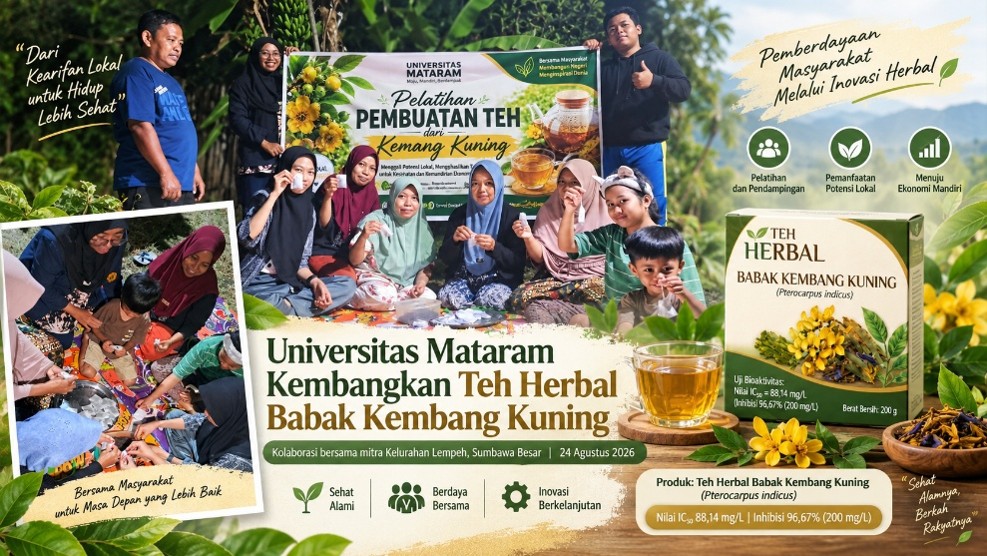
Sumbawa Besar, August 24, 2026 – The University of Mataram conducted a community empowerment program through the development of Babak Kembang Kuning Herbal Tea (Pterocarpus indicus) in collaboration with the community of Lempeh Village, Sumbawa Besar. The initiative represents an application of science and technology based on local potential, aimed at producing a herbal product that is more practical, affordable, easy to use, and has the potential to be developed into a value-added product.
Babak Kembang Kuning is a natural resource with considerable potential for development as a herbal product. However, its direct use by the community remains limited by several factors, including ease of use, processing requirements, storage, product consistency, and market appeal when directed toward community-based economic development. In response to these challenges, the University of Mataram team initiated the processing of this material into a herbal tea product that is simpler and more convenient for community use.
The product development activity was implemented through a participatory approach involving community members at various stages. The process began with an introduction to the potential of the raw material and continued with raw material preparation, processing, drying, formulation, packaging, and product-serving demonstrations. Participants not only learned how to produce the herbal tea but also gained an understanding of the importance of material and equipment hygiene, process consistency, packaging quality, product information, and standardization for future product development.
One of the main objectives of the activity was to transform the natural material into a more practical product. By formulating it as herbal tea, users no longer need to carry out complicated preparation procedures prior to consumption. The product can be packaged in convenient individual portions, making it easier to prepare, particularly for household use.
In addition to the production process, the activity also emphasized product design and identity. The packaging of Babak Kembang Kuning Herbal Tea was designed to display the product identity, the scientific name of the raw material, Pterocarpus indicus, usage information, and supporting information regarding its bioactive characteristics. Packaging development is an important component because product success depends not only on the material and production process, but also on practicality, aesthetics, informative labeling, and consumer recognition.
Supported by Bioactivity Data
The development of Babak Kembang Kuning Herbal Tea was further supported by bioactivity testing data. Laboratory testing showed an IC₅₀ value of 88.14 mg/L, providing an indication of the biological activity of the material under laboratory conditions.
In addition, the test results demonstrated an inhibition percentage of 96.67% at a concentration of 200 mg/L. The product was also found to contain several active compounds that may contribute to the observed biological activity.
These findings provide an initial scientific basis for the continued development of Babak Kembang Kuning through more comprehensive studies. However, the bioactivity data should be regarded as laboratory-based findings and should not be directly interpreted as evidence of therapeutic efficacy in humans. Further development will require safety assessment, raw material standardization, quality testing, and regulatory compliance before the product can be marketed more broadly.
The use of scientific data represents one of the key strengths of this initiative. The product is not developed solely on the basis of traditional or empirical use of natural materials, but is increasingly directed toward evidence-based product development. This approach enhances the potential for the innovation to be developed into a more consistent, measurable, and academically as well as economically valuable product.
Community Members Directly Involved in the Production Process
The activity in Lempeh Village was not limited to demonstrations by the University of Mataram team; community members were directly involved in the preparation and packaging of the herbal tea. Participants took part in various stages of production, allowing knowledge transfer to take place through hands-on practice.
Community participation is essential because the sustainability of the product depends heavily on the community’s ability to independently replicate the production process after the program has ended. For this reason, the activity was designed not only to produce a finished product but also to build fundamental production skills.
The activity documentation shows community members participating in the preparation and packaging of the material into individual product units. This approach is expected to strengthen a sense of ownership of the innovation while providing direct experience in transforming local materials into value-added products.
The program also created opportunities for interaction between the university and the community. Knowledge generated through higher education and research can be applied in real community settings, while community needs and practical experience can provide valuable feedback for further product development.
A More Practical and Economically Valuable Product
One of the main outcomes of the activity was the development of Babak Kembang Kuning Herbal Tea, which offers greater practicality than conventional use of the raw material. The product was designed for simple brewing, making it easier to use in everyday life.
From an economic perspective, processing local raw materials into packaged products can create greater added value than selling or using them in their unprocessed form. This added value may arise from processing, packaging, product identity, ease of use, and expanded marketing opportunities.
Through this approach, the benefits of the activity extend beyond the use of the plant as a herbal ingredient and create opportunities for economic activities based on local natural resources. If developed consistently, the product has the potential to support the diversification of household- or community-based enterprises.
Delivering Benefits to the Wider Community
The beneficiaries of Babak Kembang Kuning Herbal Tea development are not limited to the participants in Lempeh Village. The product is intended to benefit the wider community, particularly because its processed form offers greater convenience than direct preparation of the raw material.
At the initial stage, the benefits of the program can be observed through increased community knowledge of herbal material processing and simple production techniques. At subsequent stages, these benefits may expand to include improved packaging skills, stronger product identity, and greater capacity for independent production.
In the longer term, this innovation has the potential to generate economic benefits if it is further developed into a commercial product that meets applicable quality and regulatory requirements.
Accordingly, the impact of the initiative can be grouped into three main dimensions: knowledge enhancement, skills development, and potential economic impact.
Connecting Research with Community Engagement
This initiative also demonstrates the integration of research and community engagement. Data on active compound content, IC₅₀ values, and inhibitory activity were not limited to laboratory findings but were also used as a basis for developing a product that could be introduced to the community.
This model is consistent with the concept of research downstreaming, in which scientific knowledge and findings are translated into technologies, products, or innovations with practical applications.
Universities play an important role in ensuring that research outcomes go beyond scientific publications and generate direct benefits for society. The development of Babak Kembang Kuning Herbal Tea provides a practical example of how local natural resources can be advanced through a combination of research, product innovation, and community empowerment.
Future Development Directions
Although the product has been successfully developed at an initial stage, several additional steps are required to improve its readiness for broader use. Future development may focus on raw material standardization, formulation optimization, moisture-content analysis, product stability, microbiological safety, shelf-life determination, more comprehensive analysis of active compounds, and sensory evaluation.
Beyond laboratory development, attention must also be given to legal and commercialization aspects. If the product is intended for the market, it must comply with applicable requirements related to licensing, labeling, product claims, and safety standards.
Marketing strategies can also be developed through social media, digital catalogues, online marketplaces, and community-based promotion. These approaches may help broaden the product’s market reach while strengthening its local identity.
Further product development may also include formulation diversification, the development of more economical packaging, and the identification of appropriate consumer segments.
The University of Mataram’s Contribution to the Community
Through this initiative, the University of Mataram demonstrates its commitment to supporting local potential and community empowerment through science and innovation. Collaboration with the Lempeh Village community is expected to serve as an initial step toward the sustainable development of local products.
Babak Kembang Kuning Herbal Tea is positioned not merely as an output of the program, but also as a product prototype that can be continuously improved and further developed. With continued research, improved production quality, standardization, and strengthened entrepreneurial capacity, the product has the potential to deliver broader benefits.
The activity conducted on August 24, 2026 demonstrates that local natural resources can generate greater value when combined with scientific knowledge, appropriate processing technologies, effective product design, and active community participation.
Such collaboration between universities and communities should be continuously strengthened so that the resulting innovations do not remain at the activity stage but evolve into beneficial, sustainable, scientifically grounded products with the potential to enhance community economic value.




A WordPress Commenter says: